


Von der Leyen outlines EU’s defense
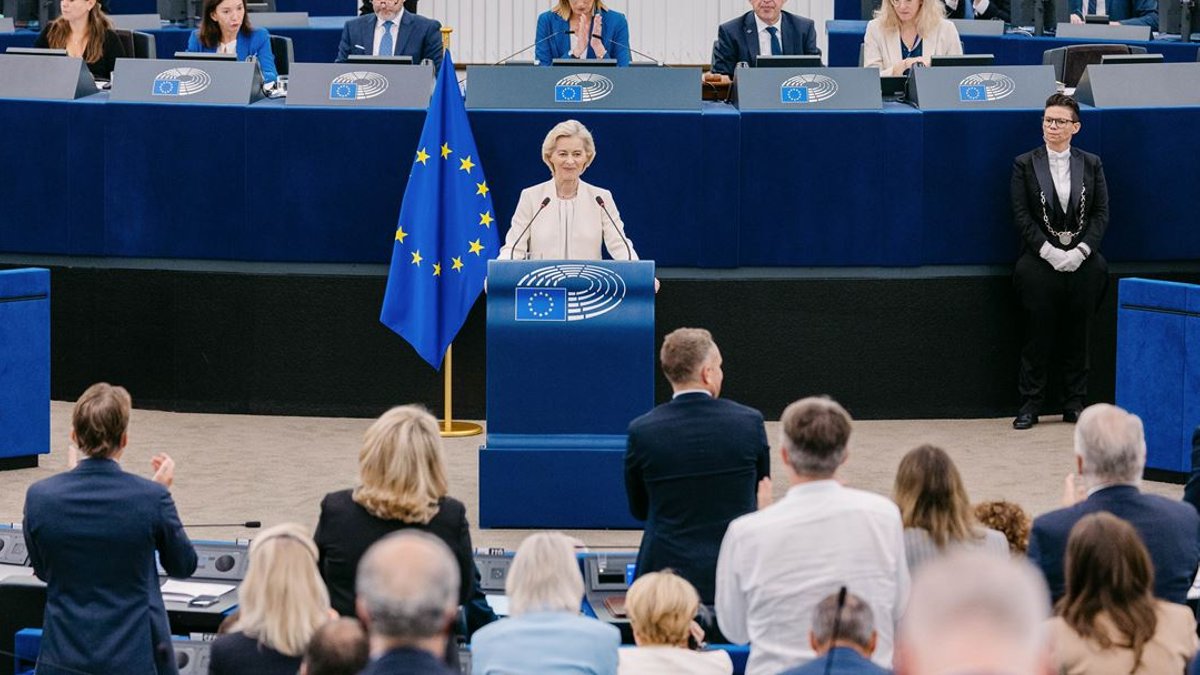
European Commission President Ursula von der Leyen’s 2026 State of the European Union address centered on reinforcing the bloc’s defenses against hybrid warfare and restricting children’s access to social media. The speech unfolded amid rising trade disputes with China, extreme weather events, and migration surges—challenges that have exposed deep divisions within the EU while testing its ability to act as a unified global actor.
Von der Leyen began with a stark evaluation of Europe’s standing. “The speed of change is incredible and the challenges exceptional,” she told the hemicycle in Strasbourg. “So if I look at Europe today, my take is this: the state of our Union is the strongest it has ever been, but it can also feel as precarious as it has ever been.” These remarks captured a bloc torn between internal conflicts over migration policies, defense strategy, and economic rivalry with China, even as it seeks to project global influence.
A key proposal involved raising Canada to the EU’s first associate member status, expanding cooperation beyond the existing Full Economic and Trade Agreement (CETA). Von der Leyen positioned this as part of a broader “Alliance for the Future,” aimed at creating “a common prosperity and economic security space” between the two partners. The initiative follows Prime Minister Justin Trudeau’s visit to Strasbourg, where he pursued deeper ties with the EU. Von der Leyen emphasized common ground in democratic values, Arctic governance, and control over critical mineral supply chains—areas where the EU aims to reduce dependence on China. “Above all, dear Mark, Europe and Canada believe in democracy,” she said, stressing coordination on technology, climate action, and defense.
EU’s Hard Line on China Trade Deficit
The address also marked a tougher stance on China, where the EU’s €1 billion daily trade deficit with Beijing has become a political vulnerability. “The second China shock is already here,” she warned, adding that the Commission would use “all tools at our disposal to rebalance our relationships.” The EU plans to establish a new European Corporation on Critical Raw Materials to secure and stockpile the materials Europe needs, as the bloc remains “more than 80% dependent on China for many critical raw materials, 90% for some rare earths.” With EU Trade Commissioner Maroš Šefčovič poised to visit his counterpart in China next month, the statement aims to strengthen the EU’s negotiating position.
However, the Commission avoided introducing new sanctions against Israel or Russia—two issues where EU member states remain sharply divided. On Israel, von der Leyen acknowledged the “deep violence” in Gaza and said the bloc would support its reconstruction through the Palestinian Donor Conference, though she did not address sanctions on settlers, a proposal that has faced resistance. “When Europe is divided, it cannot change the course of events,” she noted, framing the bloc’s inaction as a strategic weakness.
Regarding Russia, the speech called for stronger enforcement of existing sanctions rather than new penalties. Von der Leyen said the bloc has numerous security and defense tools at its disposal to counter hybrid attacks, though European doctrines “have not kept pace with the new reality.” To address this, she proposed an Emergency Security Protocol under which all member states would coordinate a European response when a hybrid threat is triggered. This would mirror NATO’s Article 4 process, allowing the EU to deter further escalation. She also announced plans for a European Security Council, bringing together partners including Canada, Norway, Ukraine, and the United Kingdom to respond to threats according to their nature and scale.
Social Media Age Limits Spark Backlash
The most debated proposal targeted children’s access to social media. Under the EU Kids Act, platforms would block users under 13, while 13- to 15-year-olds would face restricted accounts with daily time limits of one hour and enhanced safety measures. For users over 15, platforms must adopt “safe by design” standards, shifting responsibility from parents to tech companies. Von der Leyen framed the rules as a response to “digital dependency” among young people, though industry groups and free-speech advocates have criticized the approach.
“We will take a gradual and differentiated approach,” she said. “Each age has its own sensitivities. And therefore, each will have its own tailored protection level.” The plan follows summer debates over online safety, including the Ceuta migration crisis, where social media reportedly aided irregular border crossings. The Spanish exclave of Ceuta, located on North Africa’s Mediterranean coast, saw nearly 80,000 migrants cross from Morocco into Spain in July.
Migration remained a divisive topic. Von der Leyen cited a 55% decline in illegal arrivals over two years and a further 35% drop in 2026 as evidence that the Migration and Asylum Pact, finalized in June, is delivering results. She proposed a European Emergency Response Framework to allow procedural flexibility during surges, though operational details were absent.
Von der Leyen’s discussion of AI safety showed the EU’s lag in developing frontier models, where the U.S. and China lead. She emphasized the bloc’s focus on “practical AI applications”, such as medical diagnostics, supply chain optimization, and precision farming, as areas where Europe could take the lead. The Commission plans to engage major AI labs in discussions on “pacing the frontier,” though no funding or commitments were announced. The speech positioned AI as a tool to “augment” human capabilities, aligning with the EU’s emphasis on “human agency.”
Her remarks came as the bloc faces pressure to close its AI gap after years of fragmented research and limited private investment. While the U.S. and China pour resources into cutting-edge models, the EU has struggled with regulatory inconsistencies and weak industry backing. Von der Leyen’s call for unified national strategies suggested an effort to streamline approaches, though implementation plans remained vague.
Climate Crisis Drives EU Resilience Push
Climate adaptation dominated the address, with von der Leyen referencing Europe’s “summer of reckoning”, record heatwaves, wildfires, and droughts that devastated agriculture, waterways, and infrastructure. She cited 35,000 heatwave-related deaths, based on preliminary figures, warning that current damage was “a preview” of future climate impacts. The Commission announced a new climate resilience framework, beginning with an assessment of 100 high-risk regions to prioritize adaptation efforts. The goal is to position Europe as a leader in “adaptation solutions,” though no specific projects or deadlines were outlined.
To ease the financial burden of climate disasters, the Commission proposed a Climate Insurance Alliance to help governments manage rising costs. Currently, private insurance covers only 25% of catastrophe losses in Europe, forcing national budgets to absorb the rest. Wildfires this year alone caused €3 billion in damages, according to a Financial Times analysis. Von der Leyen also unveiled plans for a European Heatwave Plan and a European Water Initiative, while directing senior firefighters to develop proposals for a future European Firefighting Fleet to improve disaster response.
The address concluded with an announcement of a 2027 Congress of Europe to commemorate the 70th anniversary of the Treaty of Rome. The move signals an effort to counter growing skepticism about European unity, though no details on the event’s format or participants were provided.

Ireland Leads EU Council Amid Major Legislative Push


